From Gazebo to Gondola: What Happens When a Market Favourite Lands on a London Shelf
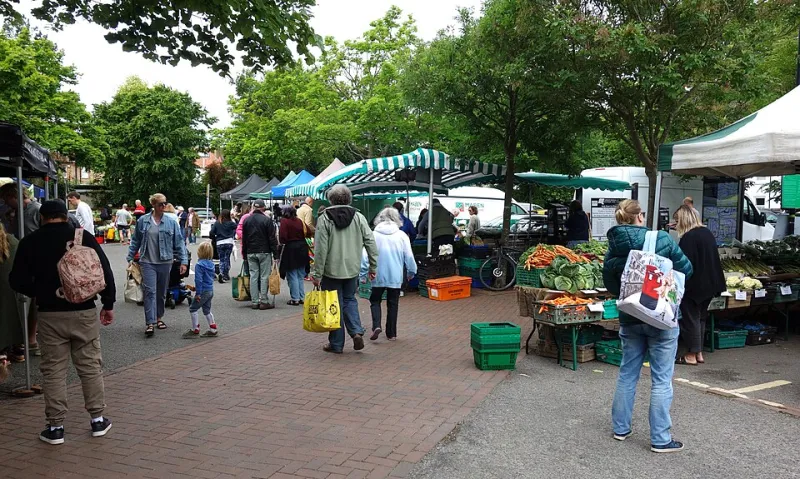
Photo: Daderot, CC0, via Wikimedia Commons
Every London farmers’ market has one: the stall with the queue. Maybe it is the granola maker from Parliament Hill, the sourdough baker at Alexandra Palace, or the chilli sauce that has people queuing at Broadway Market before the gazebo is fully up. You buy a jar, you follow them on Instagram, and then one day you see the same product on a shelf in an independent shop across town.
That moment — from market stall to shop shelf — is one of the most interesting shifts in London’s small-batch food scene. It can be a sign that a producer has found their footing. It can also be the point where the thing you loved starts to feel different. For shoppers who care about provenance, the trick is knowing what to look for.
The graduation moment
Most small-batch producers do not set out to be on a shelf. They start at a market because it is affordable, direct and gives them instant feedback. You learn quickly what sells, what people ask about, and whether your label makes sense when it is raining. A market stall is a brutal but useful editor.
The move to independent retail usually happens because a shop buyer has tasted the product and seen the queue. That is a good sign. London has a strong network of independent grocers, delis and food halls that actively look for market producers — places like the better food shops in Peckham, Hackney, Highbury and Marylebone, or the retail corners of Borough Market. When a buyer takes a chance on a market favourite, it is often because they want something with a story that is not available in the supermarket.
But graduation changes the economics. A stall can sell out and that is fine. A shop shelf needs consistency. That is where things start to move.
What changes when the gazebo comes down
Batch size is the first thing. A producer who made 80 jars a week for a Saturday market may need 300 or 400 to supply a handful of shops. That can mean bigger pans, a commercial kitchen, or a co-packer. None of those things are automatically bad. But they can change the texture of a product, the shelf life, and the way it is made.
Labelling changes too. Market labels are often charmingly handmade: a sticker, a handwritten batch code, a date. Shop labels need barcodes, ingredients lists, allergen information and storage instructions. That is not a downgrade. It is a sign that the producer is taking food safety and retail seriously. The question is whether the label still tells you something useful, or whether it has become generic brand copy.
Pricing is the third shift. A jar that cost £6 at the market may be £7.50 in a shop, and that is not necessarily greed. Retail margins, distribution and larger production runs all cost money. The useful question is not ‘Why is it more expensive?’ but ‘What am I paying for?’ If the answer is a bigger batch and a nicer label, you may want to think twice. If the answer is better ingredients, a proper kitchen and a producer who still knows their supplier, the extra pound may be fair.
Reading the label like a buyer
The label is where the story either holds up or starts to fray. Look for specifics. ‘Made in London’ is fine, but ‘made in Bermondsey’ or ‘fermented in Walthamstow’ is better. ‘Small batch’ is vague; ‘batch of 200’ is useful. ‘Natural ingredients’ tells you very little; a short, readable ingredients list tells you much more.
Check the producer’s address and contact details. A market stall often has a personal name and a mobile number. A shop label should still tell you who is behind the product. If the only information is a brand name and a website, that does not make it inauthentic, but it does mean you have less to go on.
Look at the batch code and best-before date. A very long shelf life on a product that used to be sold fresh can be a clue that the recipe has changed. A short shelf life can be a sign that the producer is still making in small runs. Neither is automatically right or wrong, but it tells you something about how the product is made.
The provenance test
The best way to judge a market favourite on a shelf is to ask whether the story still matches the product. Does the producer still appear at a market? Do they still talk about their ingredients in specific terms? Can the shop tell you who made it and where? If the answer is yes, the graduation is probably genuine.
It is also worth asking what the shop thinks. Independent buyers are usually happy to explain why they stocked something. If they say ‘the maker is still doing the farmers’ market circuit and we buy directly’, that is a good sign. If they say ‘we liked the packaging’, that is less reassuring.
A shopper’s checklist
Before you pay a shelf price for a market favourite, run through a few quick checks:
- Batch size: Is it stated? A number is better than a phrase.
- Ingredients: Is the list still short and readable, or has it grown?
- Maker details: Can you find a name, a place and a way to contact them?
- Shelf life: Does it match what you remember from the market?
- Price per unit: Compare it with the market price, not just the shelf price.
- Seasonality: Does the product still change with the seasons, or is it now available all year?
- Shop story: Can the retailer tell you why they stock it?
None of these checks is a guarantee. A producer can scale beautifully and still make something worth buying. But they help you tell the difference between a product that has grown up and one that has simply been repackaged.
London’s small-batch scene is at its best when the shelf and the stall still feel connected. The market is where the feedback happens. The shelf is where the product proves it can travel. If the jar still tastes like the person who made it, the graduation was worth it.